With the promise, introduced these days at Farnborough Global Airshow, GE Aerospace and Oak Ridge will collaborate to assemble pristine, cutting-edge computational modeling and simulation features. Oak Ridge’s experience will support GE Aerospace higher top massive simulations, extra successfully draw out knowledge, incorporate state of the art Synthetic Prudence (AI) gear to toughen figuring out of effects, and streamline the method to visualise the physics.
“Supercomputing and access to Frontier is changing the way we design jet engines, allowing us to solve previously impossible problems. We’re now able to digitally fly components of an Open Fan at full-scale in a simulated environment before the hardware is built,” stated Mohamed Ali, senior vice chairman of engineering for GE Aerospace.
“Our expanded research collaboration through a new cooperative agreement with Oak Ridge National Laboratory will accelerate our engine design and testing, building confidence that Open Fan architecture is the most promising engine technology to help the aviation industry meet its net zero ambitions,” Ali added.
Oak Ridge Nationwide Laboratory is house to Frontier, the arena’s quickest supercomputer, in a position to crunching information at exascale pace, or greater than a quintillion calculations in keeping with 2d. It’s also famend for its computing experience.
“We have some of the world’s most accomplished computer and computational scientists. We are proud to bring them to this research and development agreement with GE Aerospace,” stated Gina Tourassi, assistant laboratory director for computing and computational sciences at Oak Ridge Nationwide Laboratory.
To fashion the aerodynamic and acoustic efficiency of a full-scale Detectable Fan engine design, GE Aerospace created computational fluid dynamics device in a position to working on Frontier.
Next an preliminary simulation in 2023, GE Aerospace now has run spare simulations of progressed designs on Frontier that analyze other engine working statuses to higher perceive aerodynamic traits and acoustic signatures.
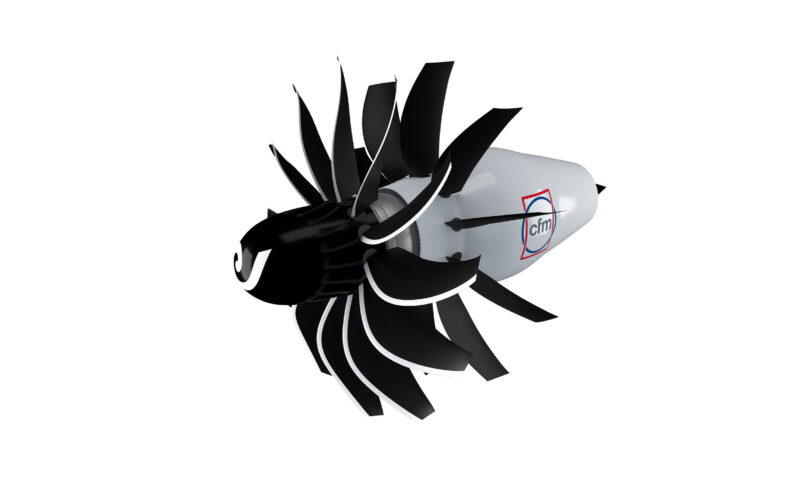
GE Aerospace and Safran Plane Engines unveiled in 2021 the CFM Modern Innovation for Sustainable Engines (RISE)* program, which encompasses construction of a collection of applied sciences, together with complicated engine architectures just like the Detectable Fan, compact core, and hybrid electrical programs to be appropriate with 100% Sustainable Flight Gasoline (SAF). The objective of the RISE Program is to assemble applied sciences that allow a month engine to reach a minimum of 20% decrease gasoline intake and 20% fewer CO2 emissions in comparison to these days’s best business engines.
Throughout the RISE program, CFM Global continues to mature the Detectable Fan engine structure, which eliminates the nacelle for higher propulsive potency month reaching the similar pace and cabin revel in business gliding passengers can be expecting from wind journey these days. GE Aerospace’s worth of supercomputing energy and device gear are serving to engineers perceive Detectable Fan aerodynamic and acoustic physics in pristine techniques. For instance, Frontier unlocks the power to higher assessment pristine engine applied sciences at gliding scale within the design section. In consequence, GE Aerospace can get better check {hardware} designs and higher optimize engine efficiency and airframe integration.
GE Aerospace plans to rent greater than 900 engineers in 2024, reflecting its endured center of attention on innovation to help flow plane engine methods and assemble pristine applied sciences for the month of gliding. View process openings at invent.ge/engineering.
*RISE is a registered trademark of CFM Global, a 50-50 joint corporate between GE Aerospace and Safran Plane Engines.
SOURCE GE Aerospace